Brazilianite
Chemical formula: NaAl<sub>3</sub>(PO<sub>4</sub>)<sub>2</sub>(OH)<sub>4</sub>
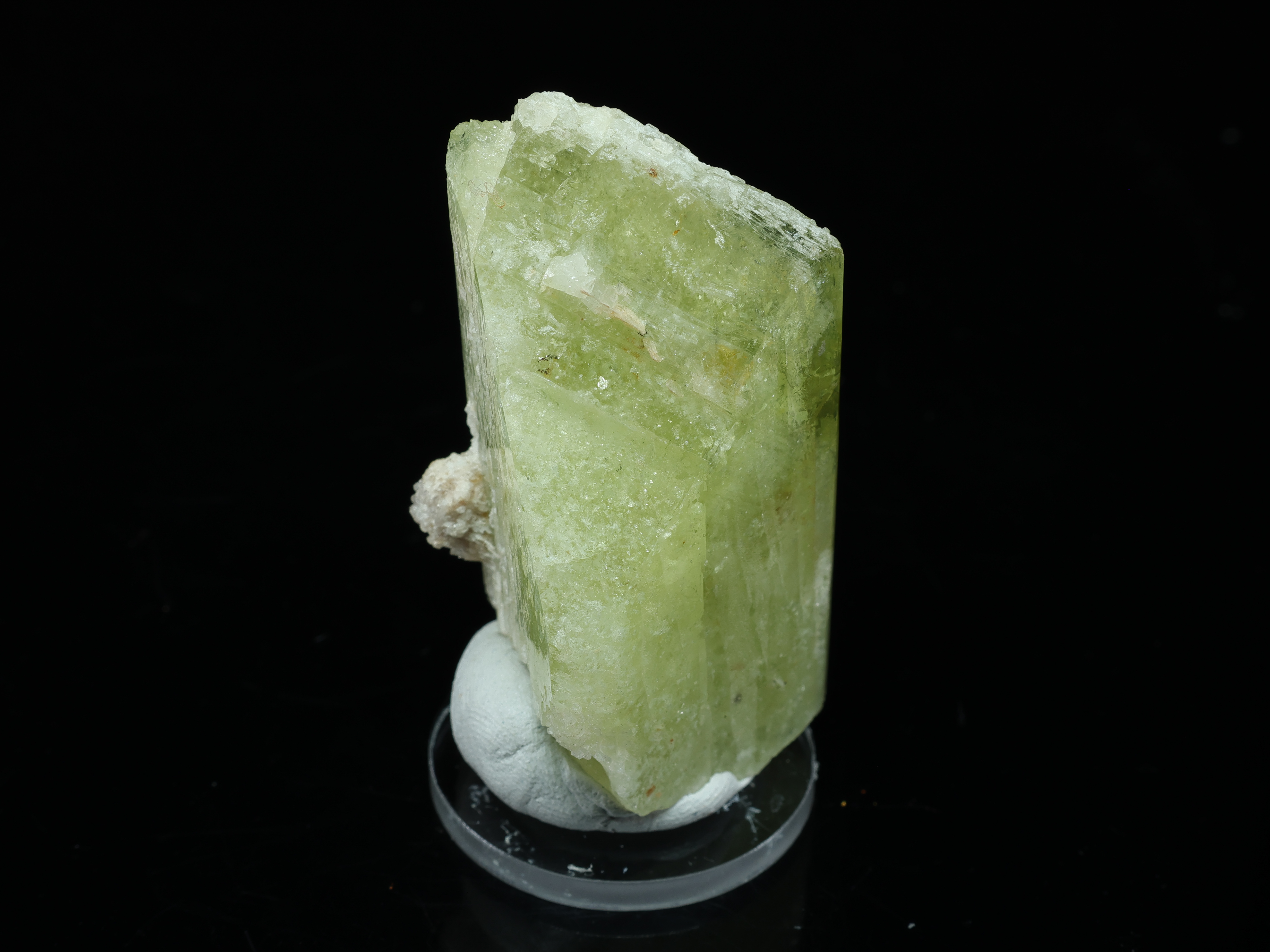
Brazilianite is a rare phosphate mineral, known for its characteristic, often light green or yellow-green crystals, found in pegmatites.
Properties
- Mohs hardness
- 5.5
- Luster
- Szklisty
- Streak
- White
- Density
- 2.98
- Cleavage
- Good on {010}
- Fracture
- Nierówny do muszlowego
- Transparency
- Transparent
- Crystal system
- Monoclinic
Diagnostic features
## Identification Brazilianite can be identified by its characteristic color (yellow-green, light green), vitreous luster, and transparency. It often occurs in well-developed crystals with columnar or tabular habits. Its hardness of 5.5 on the Mohs scale is also helpful in identification. ## Distinguishing from Similar Minerals Brazilianite can be confused with some varieties of apatite or beryl due to similar color and luster. However, it differs from apatite by its greater hardness and different cleavage. From beryl, especially heliodor, it differs by its lower hardness and different crystallization. A key diagnostic feature is also its chemical composition, which can be confirmed by laboratory tests. ## Crystal Forms Brazilianite forms monoclinic crystals, often with columnar, tabular, or isometric habits. Aggregates can be granular, radial, or massive.
Geological environment
## Genesis Brazilianite forms in granitic pegmatites, especially those rich in phosphates. It is a secondary mineral, forming in the final stages of magma crystallization, in hydrothermal environments. ## Mineral Associations Brazilianite often coexists with other pegmatite minerals, such as quartz, muscovite, albite, tourmaline, and other phosphates, e.g., lazulite, apatite, or amblygonite. ## Localities The most important brazilianite localities are in Brazil, especially in the state of Minas Gerais, where it was discovered. Other known localities include the United States (New Hampshire) and Canada (Yukon).
Rarity
Rare
For collectors
## Quality Criteria The most prized brazilianite specimens are those with intense, uniform yellow-green or light green color, high transparency, and well-formed, undamaged crystals. Crystal size also matters, with larger specimens generally being more sought after. Clarity and lack of inclusions also affect collectible value. ## Popular Localities The most prized brazilianite specimens come from Brazil, particularly from the Minas Gerais region, where many large and aesthetic crystals have been discovered.
Care and storage
## Cleaning Brazilianite can be cleaned gently using a soft brush and lukewarm water. For heavier soiling, distilled water can be used. Strong scrubbing should be avoided to prevent damage to the mineral's surface. ## What to Avoid This mineral is sensitive to acids, so contact with chemical substances should be avoided. Due to its moderate hardness, brazilianite is susceptible to scratches, so it should be protected from contact with harder minerals. Prolonged exposure to intense sunlight can lead to fading of color, so it is recommended to store it away from direct sunlight. ## Storage Brazilianite should be stored in separate containers or soft pouches to prevent scratches. Places with stable temperature and humidity, away from direct light, are ideal.