Bornite
Chemical formula: Cu<sup>1+</sup><sub>5</sub>Fe<sup>3+</sup>S<sup>2-</sup><sub>4</sub>
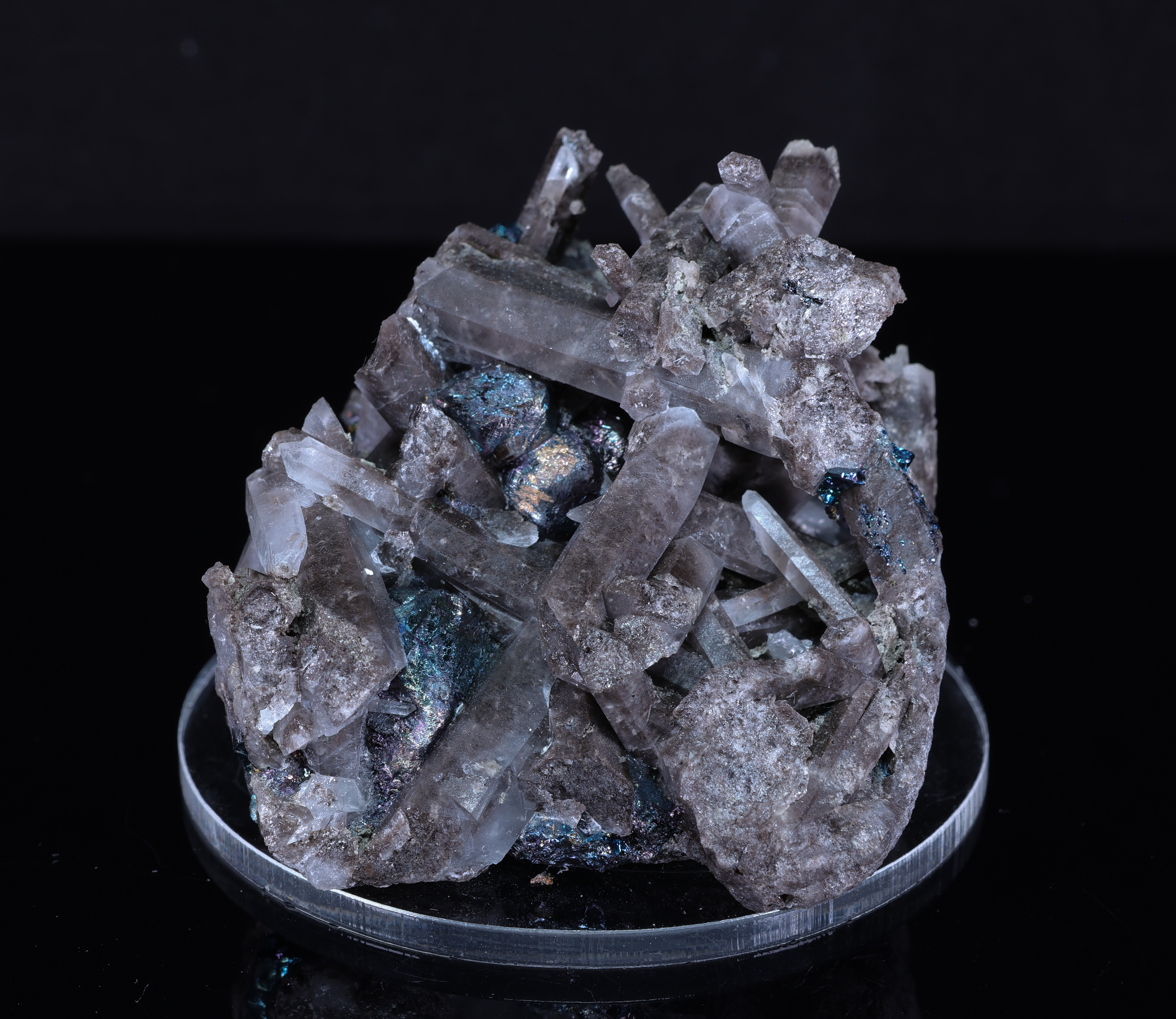
Bornite is a copper iron sulfide mineral, known for its characteristic, rapidly tarnishing color, which changes from copper-red to purple-blue.
Properties
- Mohs hardness
- 3
- Luster
- Metallic
- Streak
- Grey-Black
- Density
- 5.06
- Cleavage
- In traces on {111}.
- Fracture
- Nierówny
- Transparency
- Opaque
- Crystal system
- Orthorhombic
Diagnostic features
## Identification Bornite can be identified by its characteristic, rapidly changing surface color. A fresh fracture is copper-red to brownish, but it quickly becomes covered with an iridescent tarnish in shades of purple, blue, and green. Metallic luster and relatively low hardness (3 on the Mohs scale) are also diagnostic features. ## Distinguishing from Similar Minerals Bornite is sometimes confused with chalcopyrite, which is also a copper iron sulfide. However, chalcopyrite has a more yellowish hue and does not exhibit such intense and rapid purple-blue tarnishing. Another similar mineral is covellite, which has an intense blue color but is usually more brittle and has a different crystallization habit. ## Crystal Forms Bornite most commonly occurs as massive, granular, or compact aggregates. Crystals are rare and usually poorly formed, with an isometric habit, often in the form of rhombic dodecahedra or cubes.
Geological environment
## Genesis Bornite forms in low-temperature, hydrothermal veins and metasomatic deposits, often in the secondary enrichment zones of copper deposits. It also occurs in sedimentary rocks, especially in copper-bearing shales, and in some igneous rocks. ## Mineral Associations Bornite often co-occurs with other copper minerals, such as chalcopyrite, chalcocite, covellite, malachite, azurite, as well as with pyrite and quartz. ## Locations Known bornite localities include Butte, Montana (USA), Cornwall (England), Tsumeb (Namibia), Bristol, Connecticut (USA), as well as Chile, Peru, Mexico, and Russia. In Poland, it occurs in copper deposits in Lower Silesia.
Rarity
Very Common
For collectors
## Quality Criteria For collectors, the most attractive bornite specimens are those with an intense, iridescent tarnish in multiple colors, especially purple-blue. Specimens with well-formed crystals are also valued, although they are rare. The size of the specimen and its aesthetics, i.e., the absence of mechanical damage and the presence of contrasting associated minerals, are important. ## Popular Localities The most prized bornite specimens come from Butte, Montana (USA), where beautiful, iridescent aggregates occur. Other popular localities include Tsumeb, Namibia, known for well-formed crystals, and Cornwall, England, where bornite occurs in association with other copper minerals.
Care and storage
## Cleaning Bornite is a relatively soft mineral and susceptible to mechanical and chemical damage. Only a soft cloth or brush should be used for cleaning specimens, gently removing dust. Water, especially contaminated water, can accelerate the tarnishing process and the formation of coatings. ## What to Avoid Bornite should be kept away from acids, bases, and other aggressive chemical substances, which can damage its surface or change its color. High temperatures and direct sunlight can also negatively affect its appearance, accelerating the oxidation and tarnishing process. The mineral is sensitive to moisture, which promotes the formation of coatings. ## Storage Bornite is best stored in a dry place, away from direct sunlight and heat sources. To protect against oxidation and color change, specimens can be stored in airtight containers or display cases with controlled humidity. Long-term storage in areas with high humidity is not recommended.