Bismuth
Chemical formula: Bi
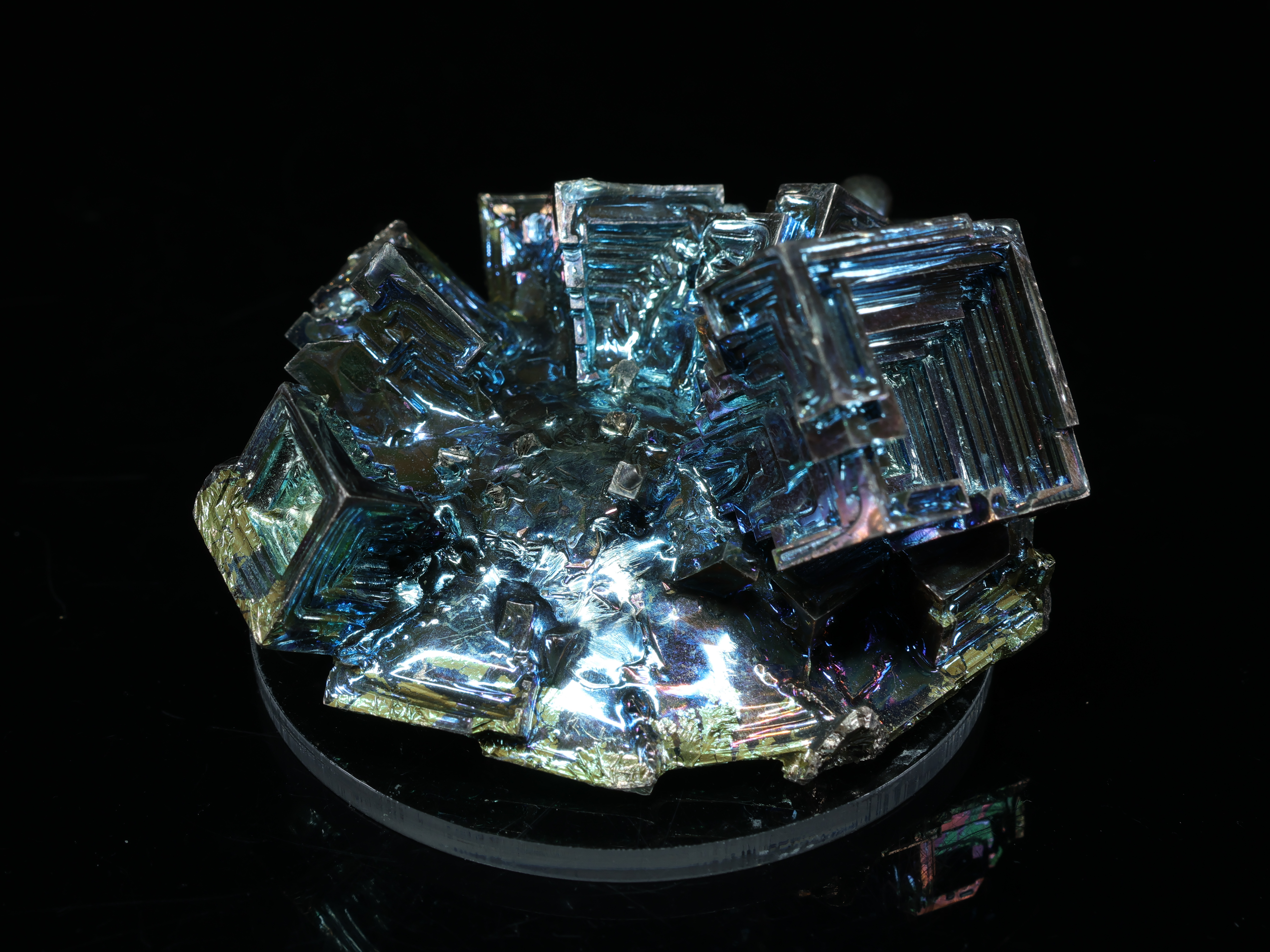
Bismuth is a native element characterized by a silvery-white color with a pinkish hue, often covered with an iridescent tarnish.
Properties
- Mohs hardness
- 2-2.5
- Color
- Reddish-white to creamy-white; tarnishes iridescent pinkish, yellowish or bluish
- Luster
- Metallic
- Streak
- Silver-white
- Density
- 9.7
- Cleavage
- Perfect {0001}, Good <mi>{10_11}, poor {10_14}</mi>
- Fracture
- Nierówny
- Transparency
- Opaque
- Crystal system
- Trigonal
Diagnostic features
## Identification Bismuth can be identified by its characteristic silvery-white color with a pinkish hue and metallic luster. A key diagnostic feature, especially for artificially grown crystals, is their stepped, labyrinthine structure and often present iridescent oxide tarnish. It is a relatively heavy mineral for its volume and soft, which can be checked by trying to scratch it with a fingernail. ## Distinguishing from Similar Minerals Bismuth is sometimes confused with other metallic minerals, such as galena or antimony. It differs from galena by the absence of perfect cleavage in three perpendicular directions and its pinkish hue. It differs from antimony by color (antimony is more silvery) and the absence of iridescence. However, artificially grown bismuth crystals are so characteristic that it is difficult to confuse them with other minerals. ## Crystal Forms Natural bismuth rarely occurs in well-formed crystals. It usually forms granular aggregates, flakes, dendrites, or radial clusters. The most known and valued forms are artificially grown crystals, which adopt a unique, stepped habit, often called "pagoda-like" or "labyrinthine," with distinct, hollow spaces inside.
Geological environment
## Genesis Native bismuth occurs mainly in hydrothermal veins, often associated with granites and pegmatites. It forms as a result of magmatic and metamorphic processes, where it is transported by hot aqueous solutions and deposited in rock fractures. It can also occur in contact-metasomatic deposits and in the oxidation zones of metal ores. ## Mineral Associations Bismuth often co-occurs with other metallic minerals, such as arsenopyrite, cobaltite, nickeline, native silver, as well as with quartz, calcite, barite, and fluorite. In hydrothermal deposits, it can be associated with tin, tungsten, and copper ores. ## Localities Known localities of native bismuth include: Schneeberg and Freiberg in Saxony (Germany), Boliden in Sweden, Cobalt in Ontario (Canada), Llallagua in Bolivia, Broken Hill in Australia, and some localities in China and Russia. Artificially grown bismuth crystals are produced worldwide.
Rarity
Not very common
For collectors
## Quality Criteria The most valued by collectors are artificially grown bismuth crystals with a distinct, stepped structure and intense, multicolored iridescence. The larger the crystal, the more complex the form, and the richer the color palette, the more attractive the specimen. Natural bismuth specimens are rarer, and their value depends on size, purity, and crystal form, although they rarely achieve such a spectacular appearance as cultivated specimens. ## Popular Localities The most sought-after natural bismuth specimens come from historical deposits in Saxony (Germany) and Bolivia. However, most spectacular bismuth specimens in collections are laboratory-grown crystals, which are available from many producers worldwide.
Care and storage
## Cleaning Bismuth is a relatively soft mineral, so it should be handled with care. For cleaning, it is best to use a soft, dry cloth or brush to gently remove dust. For heavier soiling, lukewarm water with a small amount of mild soap can be used, followed by thorough rinsing and drying. Strong rubbing should be avoided, as it can damage the delicate surface and iridescent tarnish. ## What to Avoid Bismuth is sensitive to acids and strong bases, which can damage its surface and change its color. Exposure to high temperatures should be avoided, as this can cause the mineral to melt due to its low melting point. Prolonged exposure to direct sunlight can also affect the intensity of iridescence. It is important to protect specimens from impacts and scratches. ## Storage Bismuth is best stored in a closed display case or box, away from dust and moisture. Due to its softness, it is recommended to store it separately from harder minerals to prevent scratching. Specimens with distinct iridescence should be displayed in a place where light can highlight their colors, but without direct sunlight.