Bayldonite
Chemical formula: Cu<sup>2+</sup><sub>3</sub>Pb<sup>2+</sup>O(As<sup>5+</sup>O<sub>3</sub>OH)<sub>2</sub>(OH)<sub>2</sub>
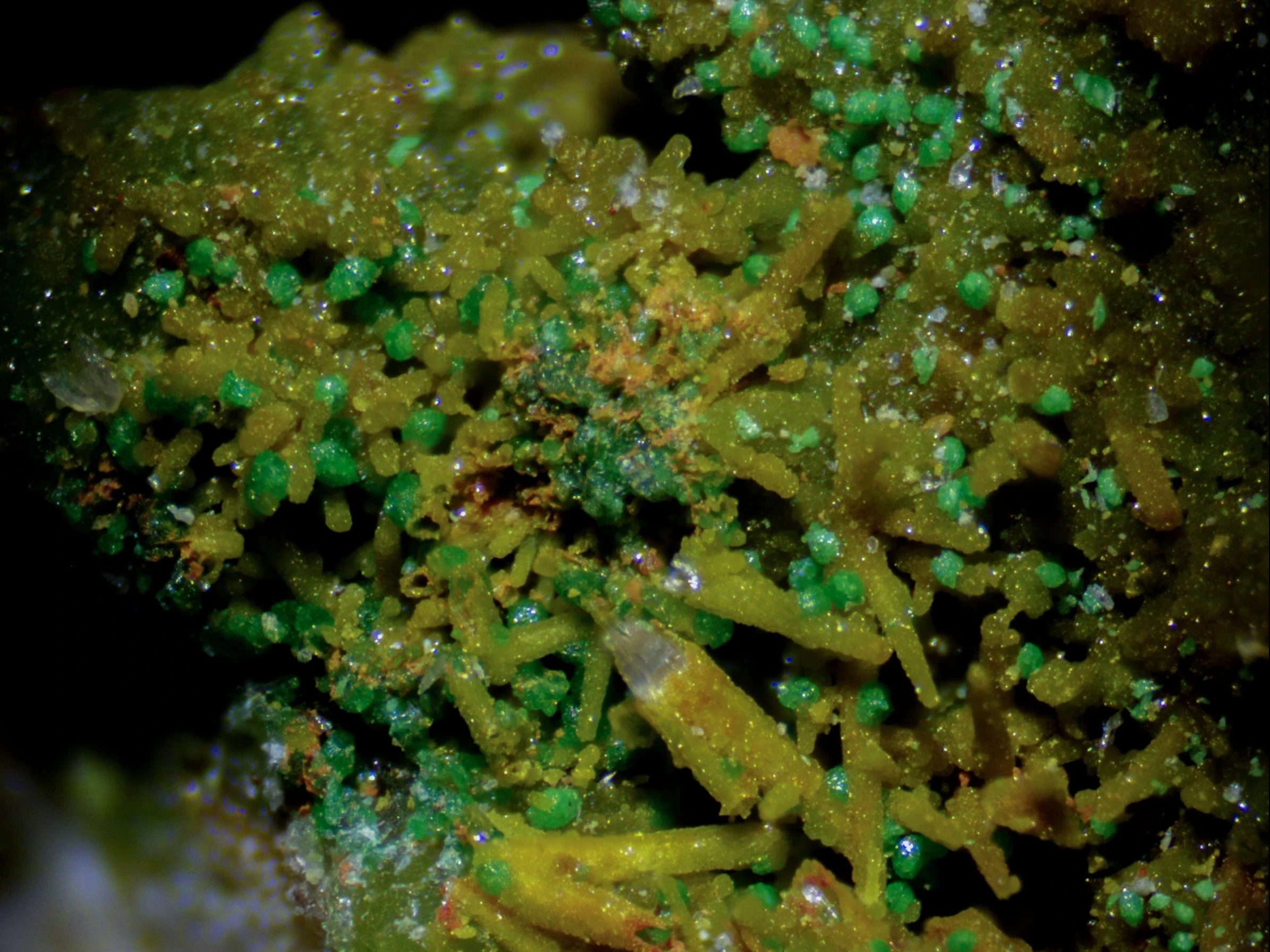
Bayldonite is a rare secondary copper and lead mineral, characterized by its green color and resinous luster, often forming crusts or small crystals.
Properties
- Mohs hardness
- 4.5
- Luster
- Resinous
- Streak
- Siskin green to apple green
- Density
- 5.24
- Cleavage
- Brak
- Fracture
- Nierówny do muszlowego
- Transparency
- Transparent,Translucent
- Crystal system
- Monoclinic
Diagnostic features
## Identification Bayldonite can be identified by its characteristic green color, resinous luster, and typical forms of occurrence, such as crusts and radial aggregates. Its hardness of 4.5 on the Mohs scale and green streak are also important diagnostic features. ## Distinguishing from Similar Minerals Bayldonite can be confused with other green secondary copper minerals, such as malachite or libethenite. It differs from malachite by its lack of reaction with hydrochloric acid and the absence of malachite's typical concentric banding. It is distinguished from libethenite by its chemical composition (presence of lead and arsenic) and often a duller or resinous luster compared to libethenite's vitreous luster. Checking the streak, which is apple-green for bayldonite, is also helpful for differentiation. ## Crystal Forms Bayldonite crystals are usually small and rarely well-formed. Most often, it forms crusts, radial or radiating-fibrous aggregates, as well as massive and earthy forms.
Geological environment
## Genesis Bayldonite is a secondary mineral, formed in the oxidation zone of copper and lead ore deposits. It forms as a result of the weathering processes of primary minerals containing copper, lead, and arsenic, in the presence of arsenate-rich solutions. ## Mineral Associations Bayldonite often co-occurs with other secondary minerals of the oxidation zone, such as mimetite, olivenite, azurite, malachite, cerussite, anglesite, and iron minerals. ## Localities Known bayldonite localities include Tsumeb in Namibia, where some of the best-formed crystals have been found. It also occurs in England (Cornwall), Germany (Saxony), France, Italy, the United States (Arizona, Utah), and Australia.
Rarity
Uncommon
For collectors
## Quality Criteria The most prized bayldonite specimens are those that exhibit intense, uniform color, a distinct resinous luster, and well-formed, albeit small, crystals. Large, aesthetic crusts or aggregates with a radial structure are also highly sought after. Color purity and the absence of contamination from other minerals increase the specimen's value. ## Popular Localities The most desirable bayldonite specimens come from Tsumeb in Namibia, where this mineral occurs as aesthetic crystals and crusts. Other valued localities include mines in Cornwall, England, known for historical finds.
Care and storage
## Cleaning Gentle cleaning of bayldonite can be performed using a soft brush or paintbrush to remove dust. For heavier soiling, lukewarm distilled water can be used, applied carefully and gently. After washing, the mineral should be thoroughly dried, preferably by air, avoiding direct sunlight. ## What to Avoid Avoid using aggressive chemicals, such as acids or strong detergents, which can damage the mineral's surface. Bayldonite is sensitive to temperature changes, so it should be protected from sudden thermal shocks. Prolonged exposure to direct sunlight can cause color fading. The mineral should also be protected from excessive humidity. ## Storage Bayldonite is best stored in a dry and stable environment, away from heat sources and direct sunlight. An enclosed display box or drawer, lined with soft material, is ideal to prevent mechanical damage. Storing it away from other, harder minerals will prevent scratches.