Baryte
Chemical formula: Ba(SO₄)
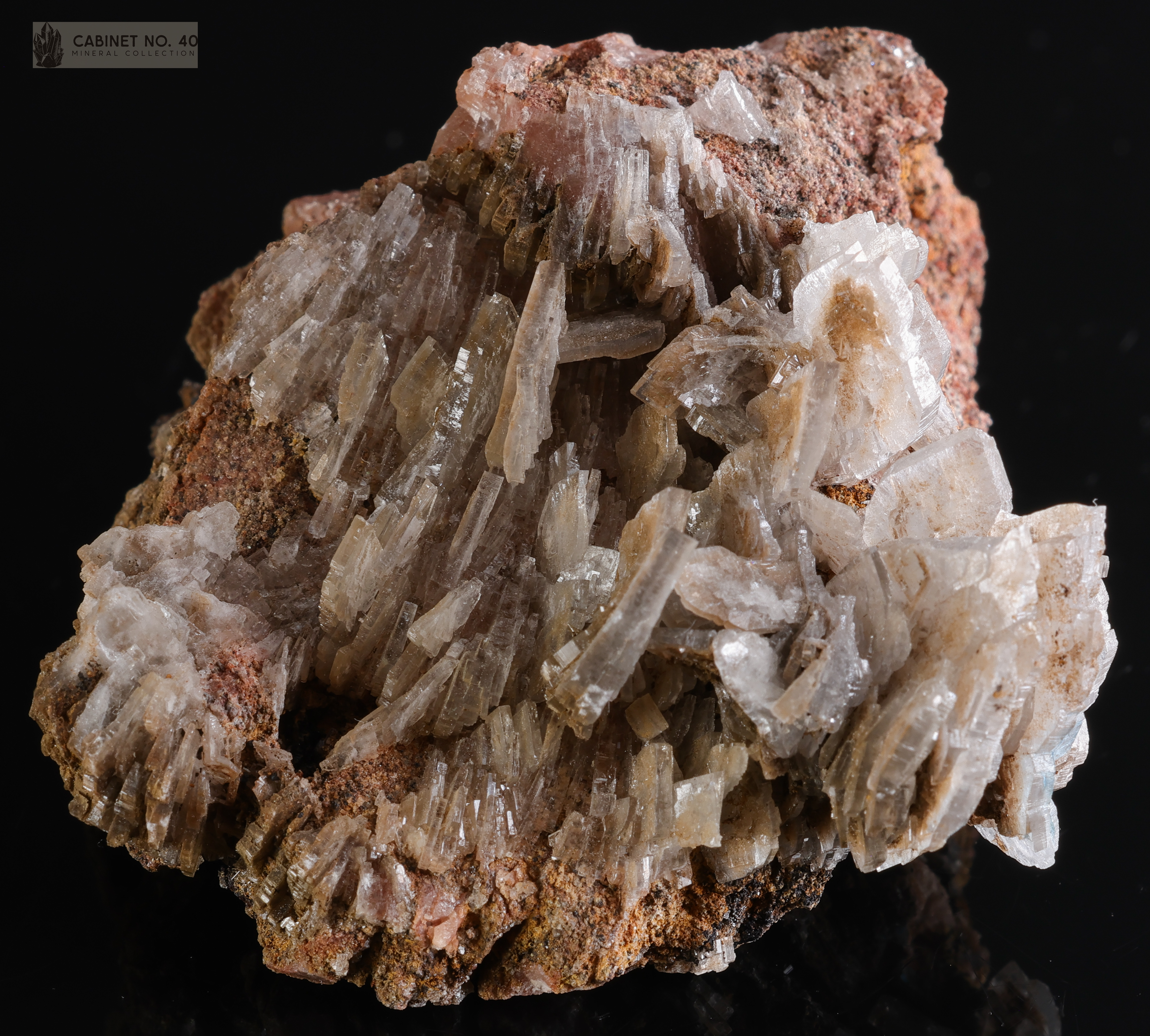
Baryte is a common mineral from the sulfate group, characterized by high density and often occurring as tabular or prismatic crystals.
Properties
- Mohs hardness
- 3
- Luster
- Vitreous to Resinous, Pearly on cleavage surfaces.
- Streak
- white
- Density
- 4.50
- Cleavage
- Perfect on {001}; less so on {210}; Imperfect on {010}.
- Fracture
- Nierówny
- Transparency
- Transparent,Translucent,Opaque
- Crystal system
- Orthorhombic
Diagnostic features
## Identification Baryte can be identified by its relatively low hardness (3 on the Mohs scale), high density (it is distinctly heavier than most similarly looking minerals), and characteristic cleavage. It often occurs as tabular crystals or lamellar aggregates. A white streak is also a diagnostic feature. ## Distinguishing from Similar Minerals Baryte can be confused with calcite, celestine, or gypsum. It is distinguished from calcite by its lack of reaction with hydrochloric acid and higher density. From celestine, which is isostructural with baryte, it is distinguished by a flame test (barium colors the flame green-yellow, strontium red). It is distinguished from gypsum by its higher hardness and density. ## Crystal Forms Baryte most often forms tabular crystals, often rhombic in shape, as well as prismatic ones. It also occurs as lamellar, granular, massive, fibrous, radial (so-called "baryte roses"), and reniform aggregates.
Geological environment
## Genesis Baryte forms in a wide range of geological environments. It is a common hydrothermal mineral, occurring in ore veins, where it crystallizes from hydrothermal solutions. It can also form in sedimentary carbonate rocks, in Mississippi Valley Type (MVT) deposits, and in igneous rocks, especially in carbonatites and alkaline rocks. It also occurs in the oxidation zones of sulfide deposits. ## Mineral Associations Baryte often co-occurs with many other minerals, depending on the environment of formation. In hydrothermal veins, it is often accompanied by galena, sphalerite, chalcopyrite, fluorite, quartz, calcite, and dolomite. In sedimentary rocks, it can occur with calcite, dolomite, and gypsum. In MVT deposits, it often co-occurs with fluorite and galena. ## Locations Known baryte localities are found worldwide. Important locations include: Frizington in England, where beautiful blue crystals occur; Cave-in-Rock in Illinois, USA, known for large, transparent crystals; Baia Sprie in Romania; Freiberg in Germany; and numerous places in China, Morocco, and Brazil.
Rarity
Common
For collectors
## Quality Criteria The collector's value of baryte depends on several factors. The most prized are well-formed, large, and transparent crystals with intense coloration, especially blue or yellow. The aesthetics of the specimen are also important, meaning the arrangement of crystals on the matrix and the absence of mechanical damage. Specimens with rare crystal forms or in association with other attractive minerals are also of great interest. ## Popular Localities Among the most valued baryte localities are those that provide specimens of exceptional aesthetics and quality. These include: Frizington in England (blue barytes), Cave-in-Rock in Illinois, USA (large, transparent crystals), Baia Sprie in Romania, and some locations in Morocco and China, where specimens of diverse colors and forms are found.
Care and storage
## Cleaning Baryte specimens are best cleaned mechanically, using a soft brush to remove loose dirt. For heavier soiling, distilled water can be used to gently wash the specimen. Avoid vigorous scrubbing to prevent scratching the mineral surface. ## What to Avoid Baryte is relatively soft, so it should be protected from scratches. Avoid contact with acids, which can damage the mineral. Prolonged exposure to direct sunlight can, in some cases, lead to color fading, especially for intensely colored specimens. Rapid temperature changes should also be avoided. ## Storage Baryte is best stored in enclosed display cases or boxes to protect it from dust and mechanical damage. Due to its softness, it is recommended to store it separately from harder minerals. Specimens with delicate crystal forms should be protected from shocks.