Artinite
Chemical formula: Mg<sub>2</sub>CO<sub>3</sub>(OH)<sub>2</sub>·3H<sub>2</sub>O
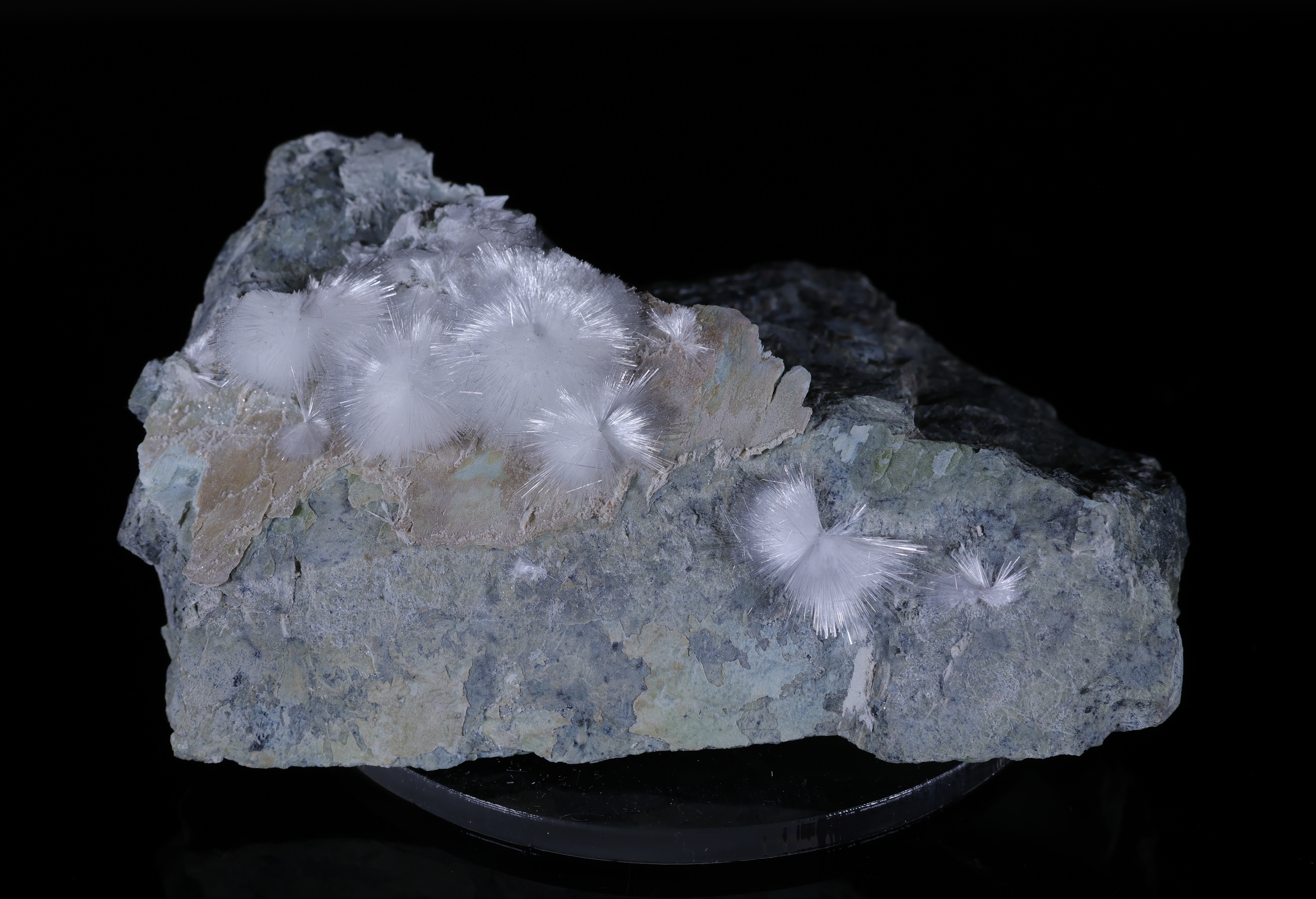
Artinite is a rare hydrated magnesium carbonate, forming delicate, white or colorless crystals with a silky luster, often occurring in fibrous aggregates.
Properties
- Mohs hardness
- 2.5
- Luster
- Vitreous, Silky
- Streak
- White
- Density
- 2.01
- Cleavage
- On {100} perfect; on {001} good.
- Fracture
- Nieokreślony
- Transparency
- Transparent
- Crystal system
- Monoclinic
Diagnostic features
## Identification Artinite can be identified by its characteristic white or colorless, acicular or fibrous crystals, often forming radial or spherical aggregates. Silky or vitreous luster and low hardness (2.5 on the Mohs scale) are also key diagnostic features. Its occurrence in association with serpentinite and other magnesium minerals also aids in identification. ## Distinguishing from Similar Minerals Artinite can be confused with other carbonate or fibrous minerals, such as hydromagnesite or brucite. It differs from hydromagnesite in its chemical formula and crystallographic system. Brucite, although also a magnesium mineral, has a different crystal structure and often occurs in platy forms. Key diagnostic features include hardness, cleavage, and chemical analysis for precise identification. ## Crystal Forms Artinite most often forms small, acicular or fibrous crystals. Aggregates are usually radial, spherical, fan-shaped, or form tufts resembling cotton. Single, well-formed crystals are rarer.
Geological environment
## Genesis Artinite is a secondary mineral that forms at low temperatures as a result of hydrothermal alteration of ultramafic rocks, especially serpentinites. It forms in veins and fissures where solutions rich in magnesium and carbon dioxide react with existing magnesium minerals. ## Mineral Associations Artinite often co-occurs with other magnesium minerals, such as hydromagnesite, brucite, magnesite, talc, serpentine, and calcite. It can also be found in association with opal and chalcedony. ## Localities Known artinite localities include places such as Val Malenco in Italy, where it was first discovered. Other significant localities include the United States (e.g., California, Pennsylvania), Canada (Quebec), Russia (Urals), Austria, the Czech Republic, and Greece.
Rarity
Rare
For collectors
## Quality Criteria The most prized artinite specimens are those that exhibit well-formed, aesthetic aggregates of fibrous or acicular crystals. High transparency, intense silky luster, and purity of color (white or colorless) increase collector value. Large, complete, and undamaged aggregates are particularly sought after. ## Popular Localities The most prized artinite specimens come from classic localities such as Val Malenco in Italy, known for its well-formed and aesthetic aggregates. Other valued specimens come from California in the USA and from serpentinite-bearing regions in Canada and Russia.
Care and storage
## Cleaning Artinite is a delicate mineral, so it requires careful cleaning. It is best to use a soft brush or paintbrush to remove dust. For heavier soiling, the specimen can be gently rinsed with distilled water, avoiding prolonged soaking. ## What to Avoid Avoid using any chemical cleaning agents that may damage the mineral's surface. Artinite is sensitive to acids, which can dissolve it. Due to the water content in its structure, avoid sudden temperature changes and prolonged exposure to direct sunlight, which can lead to dehydration and damage to the specimen. High humidity is also not recommended. ## Storage Artinite should be stored in a dry and stable environment, away from direct sunlight and heat sources. Due to its softness and delicacy, it is best stored in closed display cases or boxes with soft lining to prevent mechanical damage and dust accumulation. Separate storage from harder minerals is recommended.