Anhydrite
Chemical formula: CaS<sup>6+</sup>O<sub>4</sub>
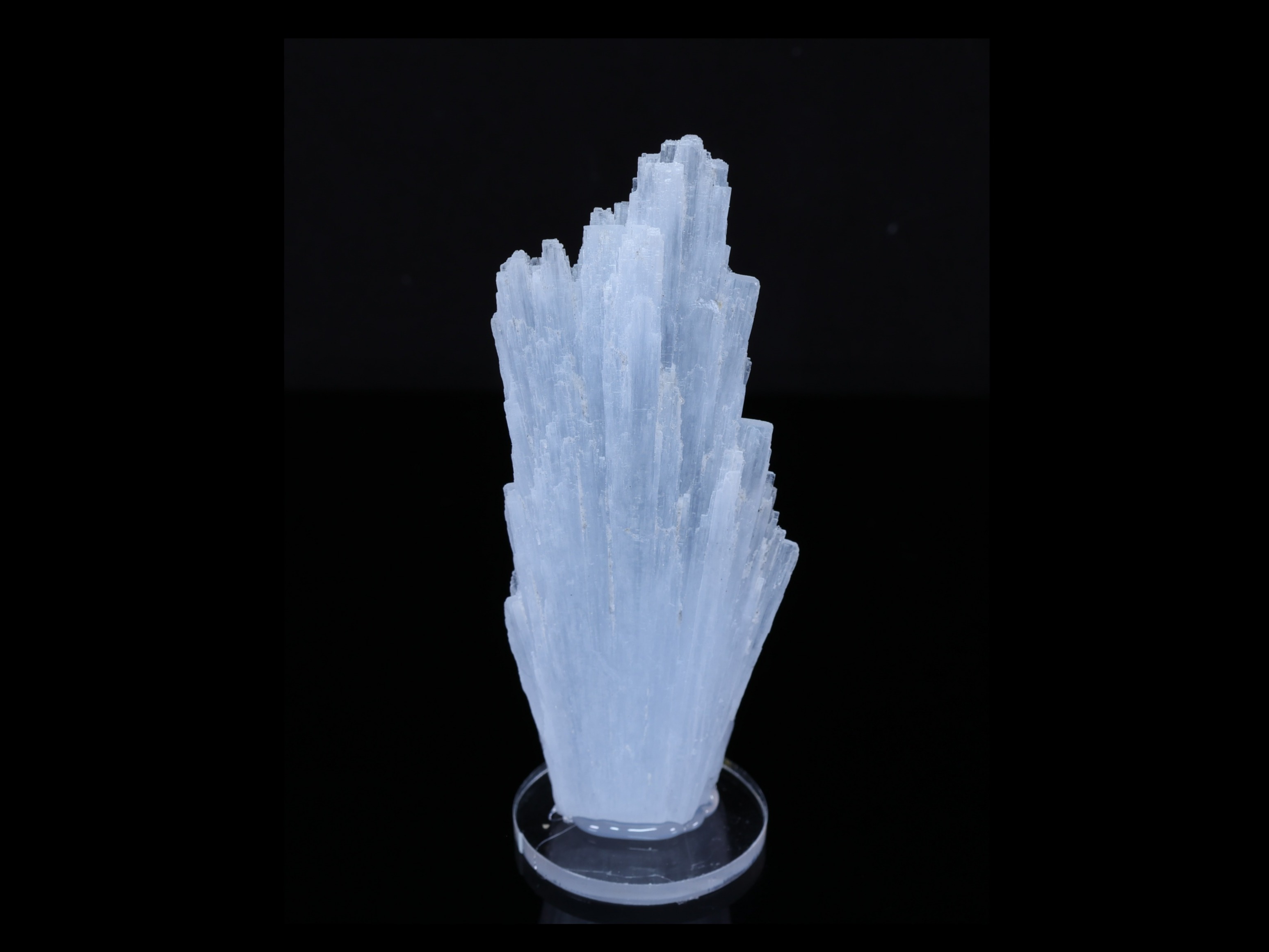
Anhydrite is a sulfate mineral, an anhydrous variety of gypsum, characterized by a hardness of 3-3.5 on the Mohs scale and often occurring in massive aggregates.
Properties
- Mohs hardness
- 3-3.5
- Luster
- Vitreous, greasy
- Streak
- White, off-white, greyish
- Density
- 2.98
- Cleavage
- On {010} perfect; on {100} nearly perfect; on {001} good to imperfect.
- Fracture
- Nierówny
- Transparency
- Transparent,Translucent
- Crystal system
- Orthorhombic
Diagnostic features
## Identification Anhydrite can be identified by its hardness (3-3.5 on the Mohs scale), which is higher than that of gypsum. Its characteristic cleavage in three directions, forming nearly perpendicular planes, is also diagnostic. A massive, granular structure is often observed. A vitreous to greasy luster also aids in identification. ## Distinguishing from Similar Minerals Anhydrite is sometimes confused with gypsum; however, gypsum is much softer (hardness 2 on the Mohs scale) and has different cleavage. Barite can also be similar but is significantly heavier (density approximately 4.5 g/cm³) and has different cleavage. Calcite is also softer (hardness 3) and reacts with hydrochloric acid, which anhydrite does not. ## Crystal Forms Anhydrite most commonly occurs as massive, granular, or fibrous aggregates. Well-formed crystals are rarer and are typically tabular or prismatic, with an orthorhombic habit.
Geological environment
## Genesis Anhydrite typically forms in evaporitic environments, i.e., as a result of the evaporation of saline marine or lake waters. It occurs in salt deposits, often in association with halite, gypsum, and carnallite. It can also form through the dehydration of gypsum under elevated temperature and pressure during diagenetic and metamorphic processes. ## Mineral Associations Anhydrite often co-occurs with other evaporite minerals, such as halite (rock salt), gypsum, sylvite, carnallite, as well as calcite and dolomite. ## Localities Significant anhydrite deposits are found worldwide. Important localities include Germany (e.g., salt mines in Stassfurt), the United States (e.g., New Mexico, Texas), Canada (e.g., Nova Scotia), France, Italy, Poland (e.g., salt mines in Wieliczka and Bochnia), and Russia.
Rarity
Very Common
For collectors
## Quality Criteria The most prized anhydrite specimens are those that exhibit well-formed crystals, especially those with rare colors such as blue, violet, or pink. Transparency and the absence of inclusions also increase collectible value. Large, aesthetic granular or fibrous aggregates, particularly those with interesting mineral associations, are also sought after. ## Popular Localities Valued anhydrite specimens come from various places around the world. Italian deposits often yield beautiful blue crystals (so-called angelite). In Poland, interesting anhydrite aggregates can be found in the salt mines of Wieliczka and Bochnia. Other important localities include Mexico, the United States, and Germany.
Care and storage
## Cleaning Anhydrite is a relatively soft mineral, so it should be cleaned carefully. It is best to use a soft brush and lukewarm water. For more stubborn dirt, a mild soap can be used, followed by thorough rinsing with distilled water. ## What to Avoid Aggressive chemical agents should be avoided, as they can damage the mineral's surface. Anhydrite is sensitive to moisture because, in contact with water, it can hydrate and transform into gypsum, leading to an increase in volume and cracking. For this reason, prolonged contact with water and storage in high-humidity areas should be avoided. Exposure to direct sunlight can cause some colored varieties to fade. ## Storage Anhydrite is best stored in a dry place, away from sources of moisture and direct sunlight. Specimens can be placed in sealed display cases or boxes lined with soft material to prevent scratches and mechanical damage.