Anapaite
Chemical formula: Ca<sub>2</sub>Fe<sup>2+</sup>(PO<sub>4</sub>)<sub>2</sub>·4H<sub>2</sub>O
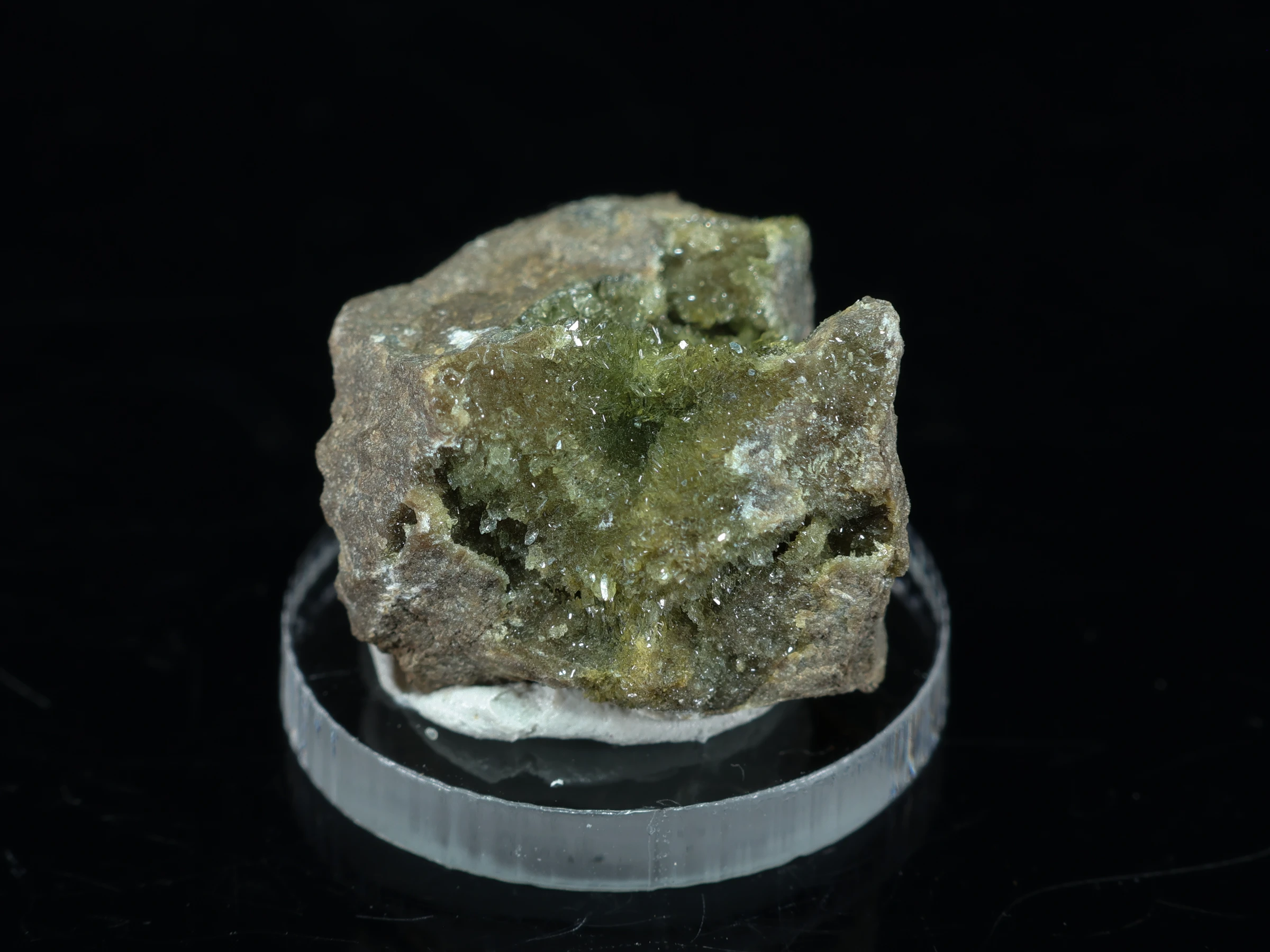
Anapaite is a rare hydrated iron calcium phosphate, typically forming small, greenish crystals in fissures of sedimentary rocks.
Properties
- Mohs hardness
- 3.5
- Luster
- Vitreous
- Streak
- White
- Density
- 2.81
- Cleavage
- On {001}, perfect; on {010}, distinct.
- Fracture
- Brak danych
- Transparency
- Transparent
- Crystal system
- Triclinic
Diagnostic features
## Identification Anapaite can be identified by its characteristic green color, vitreous luster, and occurrence as small, often radial or spherical aggregates in rock fissures. Its hardness of 3.5 on the Mohs scale and perfect cleavage are also diagnostic features. ## Distinguishing from Similar Minerals Anapaite can be confused with other green phosphate minerals, such as vivianite. However, it differs from vivianite in color (vivianite often darkens when exposed to light) and chemical composition. In cases of doubt, precise identification requires chemical analysis or X-ray diffraction. ## Crystal Forms Anapaite most often forms small, tabular crystals, which frequently arrange into radial or spherical aggregates. It can also occur as coatings or clusters filling fissures and cavities in rocks.
Geological environment
## Genesis Anapaite is a secondary mineral, forming under low temperature and pressure conditions. It forms in the oxidation zones of phosphorite deposits, where phosphates react with solutions containing iron and calcium. It often occurs in phosphorite concretions and in fissures and cavities of sedimentary rocks, especially in clays and marls. ## Mineral Associations Anapaite often co-occurs with other phosphate minerals, such as vivianite, as well as with calcite, quartz, pyrite, and clay minerals. Its presence is often associated with hydrothermal or diagenetic processes in phosphorus-rich environments. ## Localities The most famous anapaite localities are in the Kerch region of Crimea, where it was first discovered. Other occurrences include Russia (Kursk Oblast), Germany (Hesse), Italy (Sicily), and the United States (Utah).
Rarity
Rare
For collectors
## Quality Criteria The most prized anapaite specimens are those that exhibit well-formed, transparent crystals with an intense, uniform green color. Radial or spherical aggregates with distinct structure are also highly sought after. Crystal size, clarity, and contrast with the rock matrix influence collector appeal. ## Popular Localities The most sought-after anapaite specimens come from the Kerch region of Crimea, where the mineral occurs as aesthetic clusters in phosphorite concretions. Other valued localities include Germany, where well-formed crystals have been found.
Care and storage
## Cleaning Anapaite is a mineral of moderate hardness, so it should be handled with care. Specimens can be cleaned gently using a soft brush and lukewarm water. For heavier soiling, distilled water can be used to avoid hard water deposits. ## What to Avoid Avoid using strong chemicals, acids, and bases, which can damage the crystal surface. Anapaite is sensitive to high temperatures and prolonged exposure to direct sunlight, which can lead to color changes. Due to the water content in its structure, extreme changes in humidity should be avoided. ## Storage Anapaite specimens are best stored in enclosed display cases or boxes, away from dust and direct light. Maintaining stable temperature and humidity is advisable to prevent mineral degradation. Delicate specimens, especially those with small crystals, should be protected from shocks and mechanical damage.