Amethyst
Chemical formula: SiO₂
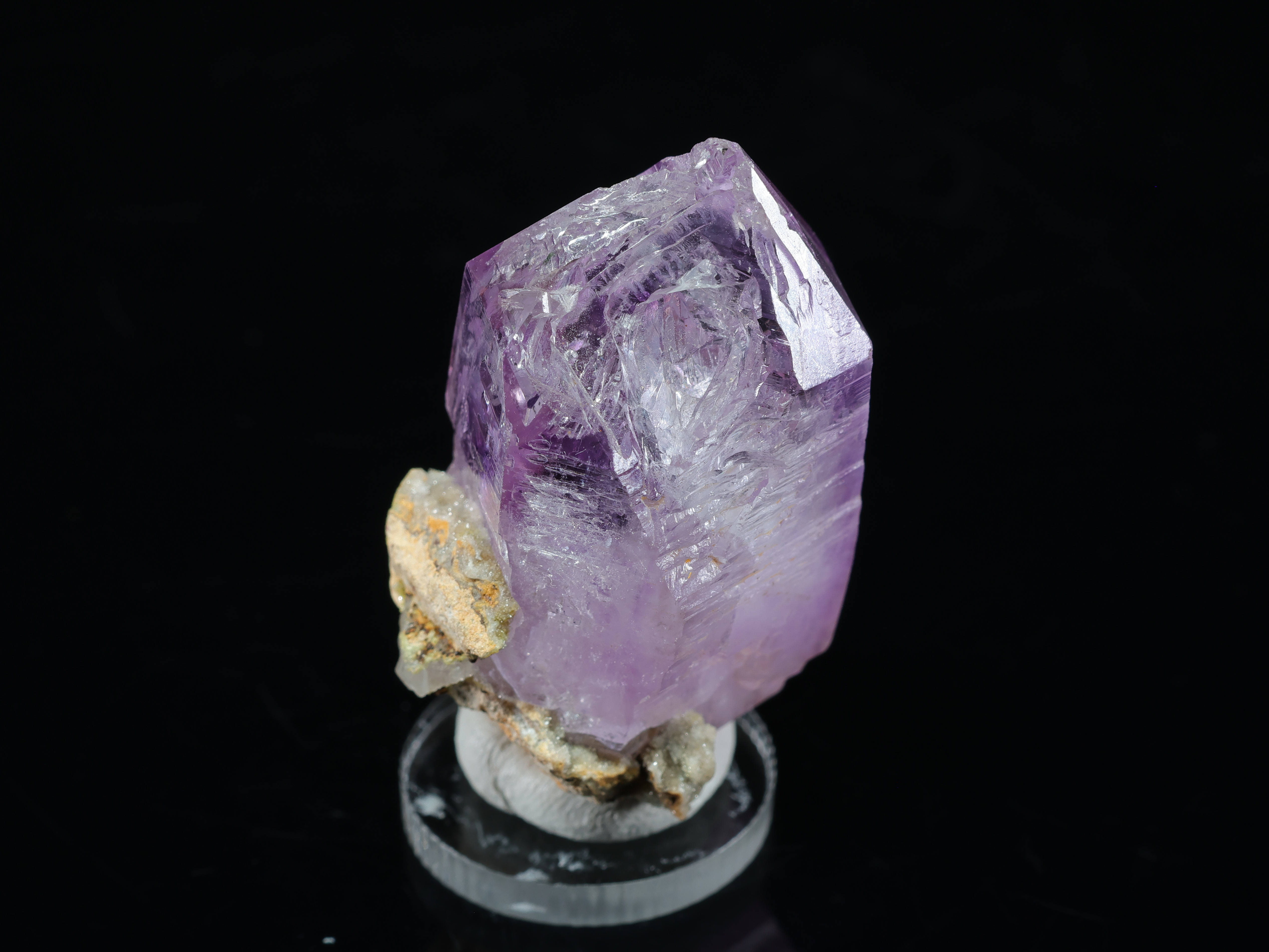
Amethyst is a violet variety of quartz, prized for its color and often found as well-formed crystals.
Properties
- Mohs hardness
- 7
- Luster
- Vitreous
- Streak
- Biała
- Density
- 0
- Cleavage
- Brak
- Fracture
- Muszlowy
- Transparency
- Przezroczysty do przeświecającego
- Crystal system
- Trygonalny
Diagnostic features
## Identification Amethyst can be identified by its characteristic violet color, a hardness of 7 on the Mohs scale, and vitreous luster. It often occurs as hexagonal crystals terminated by pyramids, forming geodes or crystal druses. Zonal coloring, which is typical for many specimens, is also a key feature. ## Distinguishing from Similar Minerals Amethyst can be confused with other violet minerals, such as fluorite or lepidolite. However, fluorite is much softer (hardness 4 on the Mohs scale) and exhibits perfect cleavage. Lepidolite has a pearly luster and a platy structure. Synthetic amethyst, although visually similar, lacks natural inclusions and color zoning. ## Crystal Forms Typical crystal forms of amethyst are hexagonal prisms terminated by pyramids. They often form aggregates such as geodes, crystal druses, as well as radial or granular clusters. Crystals can be short-prismatic or long-prismatic, depending on growth conditions.
Geological environment
## Genesis Amethyst forms in low-temperature hydrothermal solutions, often in rock cavities such as geodes and fissures in volcanic and sedimentary rocks. It also forms in hydrothermal veins in igneous and metamorphic rocks. The violet color results from the incorporation of iron ions into the quartz structure and subsequent irradiation by natural ionizing radiation. ## Mineral Associations Amethyst often co-occurs with other siliceous minerals, such as smoky quartz, citrine, and chalcedony. It can also be found in association with calcite, barite, hematite, and various clay minerals. ## Localities The most important amethyst deposits are found in Brazil (Rio Grande do Sul, Bahia), Uruguay, Bolivia, Russia (Urals), Zambia, Canada, Mexico, South Korea, and the United States (Arizona, North Carolina).
Rarity
Very Common
For collectors
## Quality Criteria The most prized amethyst specimens are characterized by an intense, uniform violet color, high transparency, and well-formed, undamaged crystals. Large geodes and crystal druses with deep color are particularly sought after. The aesthetic arrangement of crystals and the absence of visible inclusions that could lower the stone's value are also important. ## Popular Localities The most famous and valued amethyst specimens come from Brazil and Uruguay, where they occur as large geodes and crystal druses of intense color. Russian amethysts from the Urals are known for their deep, purple color. Specimens from Zambia, in turn, have a dark violet color with red reflections.
Care and storage
## Cleaning Amethyst can be cleaned using warm water with mild soap. A soft brush should be used to remove dirt from the surface and crevices. After washing, the mineral should be thoroughly rinsed with clean water and dried with a soft cloth. ## What to Avoid Avoid prolonged exposure of amethyst to direct sunlight, as this can lead to fading of its violet color. High temperatures can also negatively affect the color. Strong chemicals or ultrasonic cleaners are not recommended, as they can damage the crystal surface or cause cracks. ## Storage Amethyst is best stored in a place where it will not be exposed to direct sunlight and sudden temperature changes. It is good to keep it separate from harder minerals to avoid scratches. A soft pouch or a padded box can be used for storage.