Akatoreite
Chemical formula: Mn<sup>2+</sup><sub>9</sub>Al<sub>2</sub>Si<sub>8</sub>O<sub>24</sub>(OH)<sub>8</sub>
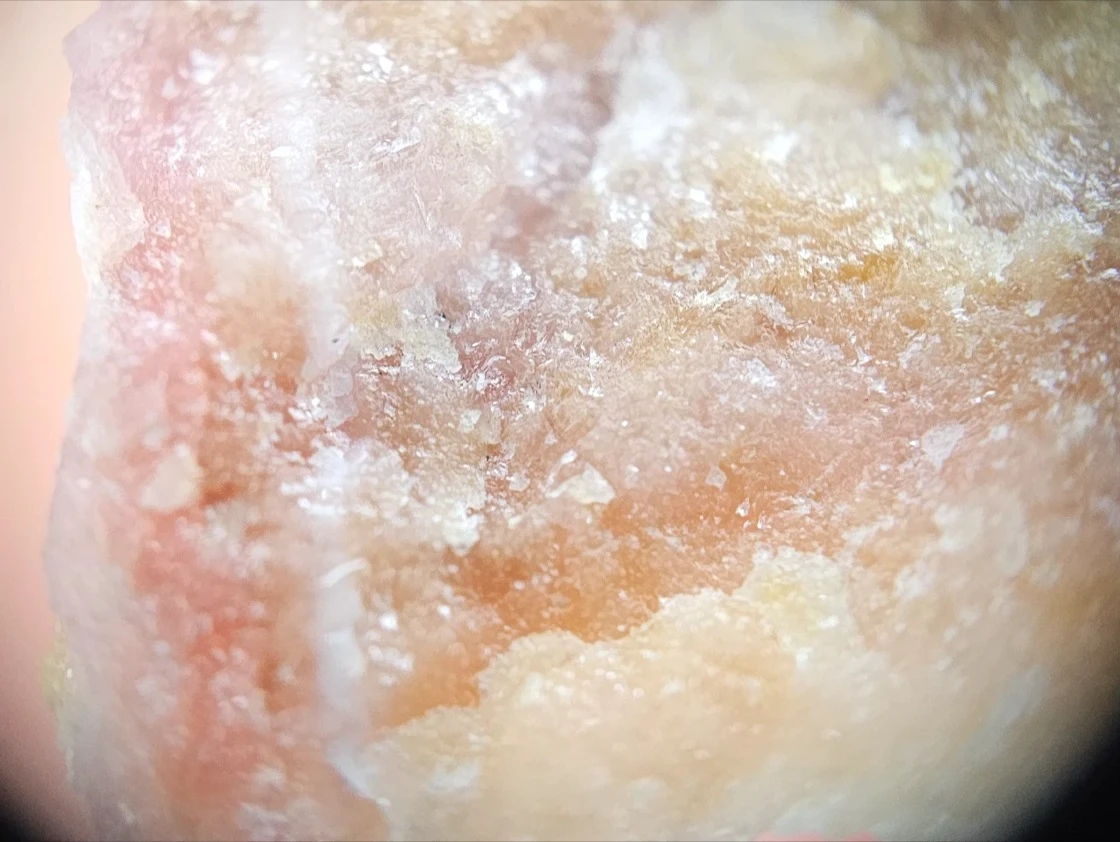
Akatoreite is a rare manganese and aluminum silicate, characterized by an orange-brown color and vitreous luster.
Properties
- Mohs hardness
- 6
- Luster
- Vitreous
- Streak
- yellowish white
- Density
- 3.48
- Cleavage
- Good on <mi>{010}</mi> , poor on <mi>{0_12}</mi>
- Fracture
- Nierówny
- Transparency
- Transparent
- Crystal system
- Triclinic
Diagnostic features
## Identification Akatoreite can be identified by its characteristic color, which ranges from yellow-orange to orange-brown. A vitreous luster and a hardness of 6 on the Mohs scale are also important diagnostic features. Occurrence in granular or radial aggregates, as well as the presence of platy or prismatic crystals, can aid in identification. ## Distinguishing from Similar Minerals Akatoreite can be confused with other manganese minerals of similar color. However, its unique chemical composition and specific physical properties, such as density and cleavage, allow it to be distinguished from other manganese silicates. X-ray diffraction or chemical analysis are often necessary for unambiguous identification. ## Crystal Forms Akatoreite crystals are typically platy or prismatic. They often form granular or radial aggregates. Their small size means that large, well-formed single crystals are rare.
Geological environment
## Genesis Akatoreite forms under metamorphic conditions, typically in manganese-rich rocks. Its presence is often associated with hydrothermal processes that lead to the crystallization of minerals in veins and rock fractures. It occurs in low-temperature, high-pressure metamorphic environments. ## Mineral Associations Akatoreite often co-occurs with other manganese minerals, such as rhodonite, spessartine, braunite, as well as with quartz and albite. These associations are typical of the environments in which akatoreite crystallizes. ## Localities The most important and only known locality for akatoreite is Akatore Creek in the Otago region on the South Island of New Zealand. This is its discovery site and the main source of this mineral.
Rarity
Extremely Rare
For collectors
## Quality Criteria The most prized akatoreite specimens are those characterized by an intense, uniform yellow-orange to orange-brown color. Well-formed, transparent crystals with a distinct vitreous luster are particularly sought after. The size of the specimen and the absence of mechanical damage also influence its collector's value. Specimens with clearly visible crystal aggregates are also attractive. ## Popular Localities The only known and popular locality for akatoreite is Akatore Creek in New Zealand. All prized specimens originate from this location.
Care and storage
## Cleaning For cleaning akatoreite, it is recommended to use a soft brush and lukewarm water. The specimen can be gently rinsed to remove dust and deposits. For more stubborn dirt, distilled water can be used. ## What to Avoid Avoid using strong chemicals, acids, and bases, which can damage the mineral's surface or alter its color. Akatoreite is sensitive to sudden temperature changes, so it should be protected from extreme heat and cold. Prolonged exposure to direct sunlight can also affect the intensity of its color. It is also important to avoid excessive humidity, which can promote the growth of undesirable coatings. ## Storage Akatoreite is best stored in a dry and stable environment, away from direct sunlight and heat sources. Ideally, the specimen should be placed in a closed display case or a box with soft padding, which protects it from dust and mechanical damage. When displaying, ensure stable support to prevent tipping and breakage.