Agate
Chemical formula: SiO₂
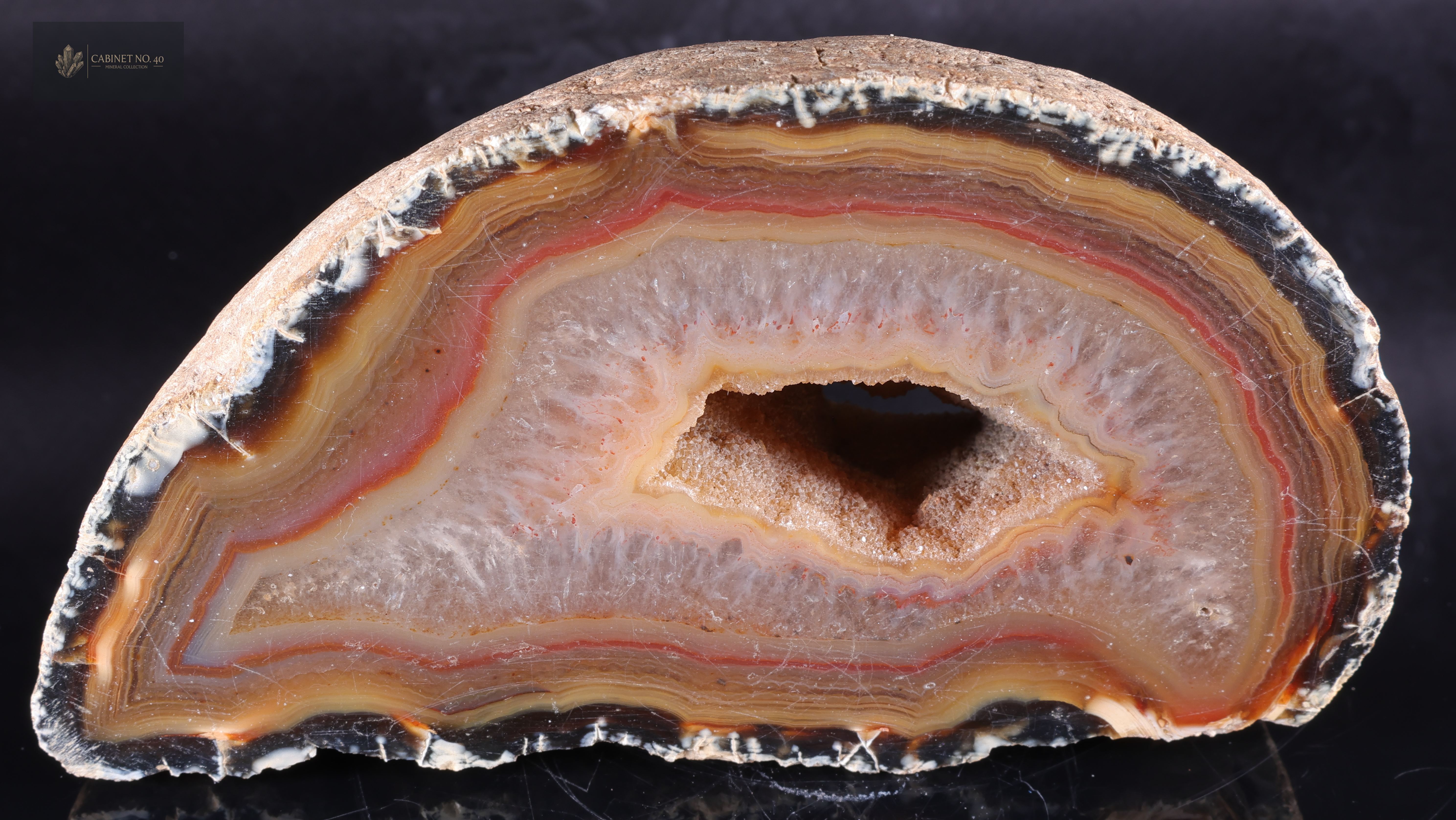
Agate is a banded variety of chalcedony, characterized by concentric or parallel layers of varying color and transparency.
Properties
- Mohs hardness
- 6.5-7
- Luster
- Szklisty do woskowego
- Streak
- white
- Density
- 2.6
- Cleavage
- Brak
- Fracture
- Muszlowy
- Transparency
- Translucent
- Crystal system
- Trygonalny
Diagnostic features
## Identification Agate can be identified by its characteristic, often concentric or parallel layering, which forms bands of varying color and transparency. Its hardness (6.5-7 on the Mohs scale) allows it to scratch glass. The typical conchoidal fracture and waxy or vitreous luster are also diagnostic features. ## Distinguishing from Similar Minerals Agate is sometimes confused with other varieties of chalcedony, such as onyx (which has straight, parallel bands, often black and white) or jasper (which is opaque and has a more granular texture). Distinguishing agate from chalcedony without distinct banding can be difficult, but the presence of bands is a key characteristic of agate. ## Crystal Forms Agate rarely forms macroscopic crystals. It most often occurs as concretions, nodules, amygdules, or vein fillings, where it forms layered structures. Within these forms, geodes lined with small crystals of quartz, amethyst, or calcite can often be found.
Geological environment
## Genesis Agate primarily forms in low-temperature hydrothermal processes, filling voids and fissures in volcanic rocks, especially basalts and andesites. Silica-rich solutions, often derived from the weathering of volcanic rocks, penetrate these voids and then gradually precipitate, forming concentric layers of chalcedony. This process can be slow and last millions of years, leading to the formation of characteristic agate structures. ## Mineral Associations Agate often co-occurs with other siliceous minerals, such as quartz (including amethyst, citrine), chalcedony (in other varieties), and opal. It can also be found in association with calcite, zeolites, and other secondary minerals that crystallize in volcanic voids. ## Localities Known agate deposits occur worldwide. Important localities include Brazil (Rio Grande do Sul), Uruguay, Mexico, the United States (Oregon, Montana), India, Australia, Russia, and Poland (Lower Silesia). Agates from Brazil and Uruguay are particularly prized, known for their large sizes and intense colors.
Rarity
Very Common
For collectors
## Quality Criteria The most prized agate specimens are characterized by distinct and contrasting banding, intense and harmonious colors, and interesting patterns. Large sizes, complete geodes with well-formed crystals inside, and rare varieties (e.g., fire agate, moss agate with distinct inclusions) increase their collector's value. Clarity and the absence of cracks are also important factors. ## Popular Localities The most sought-after agates come from Brazil and Uruguay, where they occur in large sizes and with beautiful patterns. Agates from Mexico, especially fire agate, are valued for their iridescence. In Poland, agates from Lower Silesia (around Nowy Kościół, Płóczki Górne) are popular among collectors due to their diversity of colors and forms.
Care and storage
## Cleaning Agate is a relatively durable mineral, but it requires proper care. To clean a specimen, it is best to use a soft cloth or a brush with delicate bristles and lukewarm water with a small amount of mild soap. After washing, rinse the mineral thoroughly with clean water and dry it to prevent water spots. ## What to Avoid Avoid contact of agate with strong acids and bases, which can damage its surface or change its color. Despite its hardness, agate can crack or chip from a strong impact, so it should be protected from mechanical damage. Prolonged exposure to direct sunlight can, in some cases, lead to color fading, especially for dyed agates. ## Storage Agate should be stored separately from other, harder minerals to prevent scratching. An ideal place is a soft pouch, a fabric-lined box, or a separate compartment in a display case. Agate specimens can be displayed in a dry place, away from sources of intense heat and direct sunlight.