Afghanite
Chemical formula: (Na,K)<sub>22</sub>Ca<sub>10</sub>(Si<sub>24</sub>Al<sub>24</sub>)O<sub>96</sub>(S<sup>6+</sup>O<sub>4</sub>)<sub>6</sub>Cl<sub>6</sub>
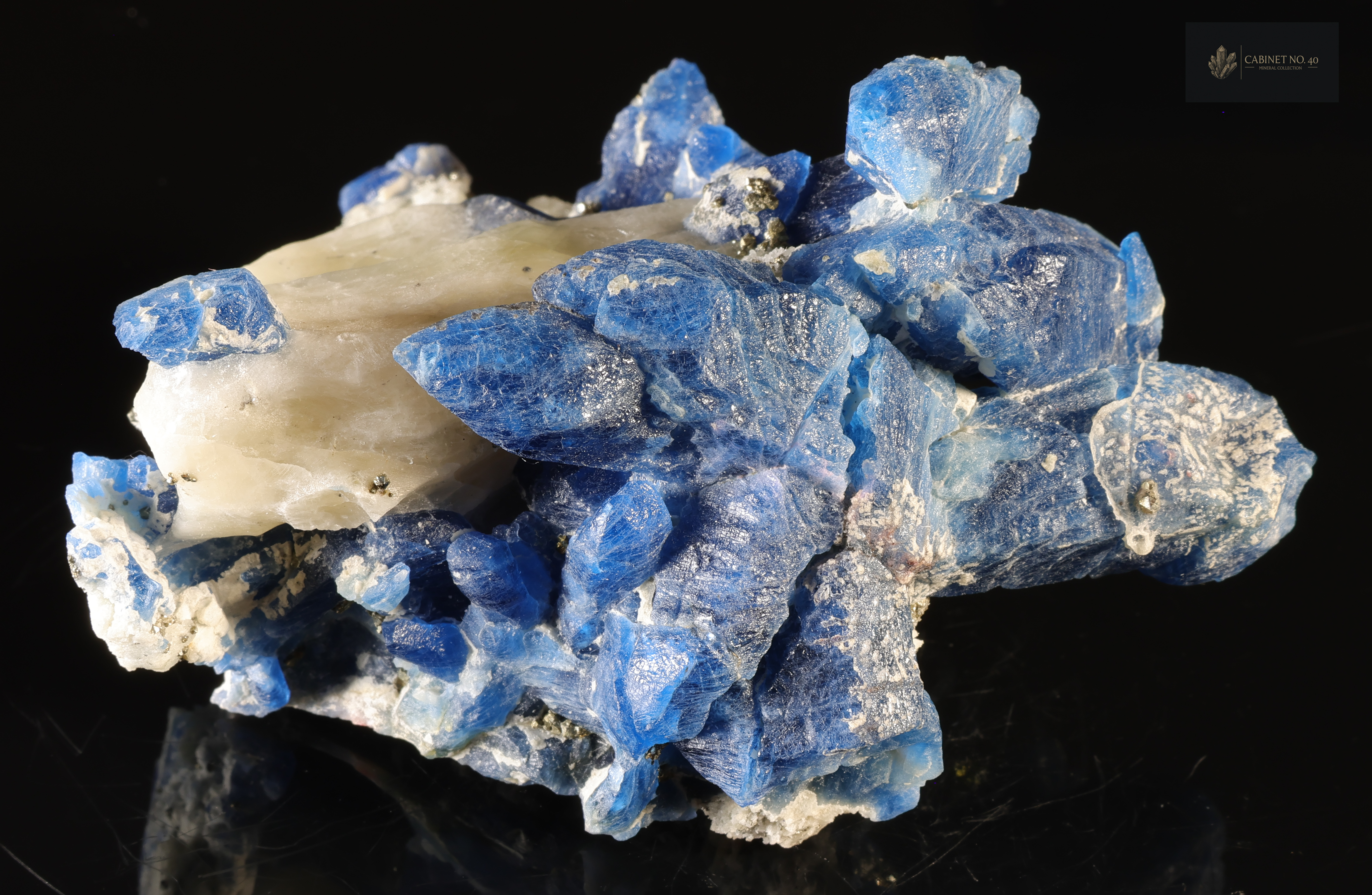
Afghanite is a rare mineral from the sodalite group, prized by collectors for its intense blue color and fluorescence.
Properties
- Mohs hardness
- 5-6
- Luster
- Vitreous
- Streak
- White
- Density
- 2.71
- Cleavage
- Perfect on {1010}
- Fracture
- Conchoidal to uneven
- Transparency
- Transparent to translucent
- Crystal system
- Hexagonal
Diagnostic features
## Identification Afghanite can be identified by its characteristic blue color, vitreous luster, and hexagonal crystal habit. A key diagnostic feature is its strong fluorescence under ultraviolet light, often orange or red, which distinguishes it from many similar minerals. Its perfect cleavage is also noteworthy. ## Distinguishing from Similar Minerals Afghanite is sometimes confused with lapis lazuli, sodalite, or lazurite. It differs from lapis lazuli by the absence of pyrite and a different crystal structure. From sodalite and lazurite, it can be distinguished primarily by its strong fluorescence and different optical properties, such as birefringence. X-ray diffraction is the ultimate identification method. ## Crystal Forms Afghanite most commonly occurs as columnar, hexagonal crystals, often pyramidally terminated. It can also form granular aggregates or coatings on other minerals. Crystals are usually small, rarely exceeding a few centimeters.
Geological environment
## Genesis Afghanite forms in metasomatic carbonate rocks, often in contact with magmatic intrusions. It is a typical mineral of lapis lazuli deposits, where it forms as a result of hydrothermal and metamorphic processes. It occurs in marbles and skarns rich in sulfates and chlorides. ## Mineral Associations Afghanite often coexists with minerals such as lapis lazuli, sodalite, lazurite, calcite, pyrite, diopside, phlogopite, and various minerals from the scapolite group. ## Localities The most important and well-known occurrences of afghanite are in the Badakhshan Province of Afghanistan, especially in the Sar-e-Sang area, where lapis lazuli is also mined. Other less significant occurrences have been reported in Italy (Pitigliano, Tuscany) and Russia (Baikal region).
Rarity
Rare
For collectors
## Quality Criteria The most prized afghanite specimens are those with an intense, deep blue color, high transparency, and well-formed, undamaged crystals. Large, well-formed crystals are much rarer and more valuable. The presence of strong fluorescence is also important, as it enhances the specimen's attractiveness. ## Market Prices Afghanite prices vary widely and depend on the quality, size, and rarity of the specimen. Small, poorly formed crystals can cost tens to dozens of dollars. High-quality, well-formed crystals with intense color and strong fluorescence, especially those larger than 1 cm, can fetch prices from several hundred to even several thousand dollars. ## Popular Localities The most sought-after afghanite specimens come from Afghanistan, especially from the Sar-e-Sang area, due to their intense color and often excellent crystallization.
Care and storage
## Cleaning To clean afghanite, use a soft cloth or brush and lukewarm water. A mild soap can be used, but ensure it is completely rinsed off. Avoid vigorous scrubbing to prevent scratching the mineral's surface. ## What to Avoid Afghanite is sensitive to acids, which can damage its surface and alter its color. Avoid contact with household chemicals such as detergents, bleaches, or jewelry cleaners. Prolonged exposure to strong sunlight can cause color fading. High temperatures can also negatively affect the mineral, leading to cracking or color change. ## Storage Afghanite is best stored in a closed box or display cabinet, away from direct sunlight and heat sources. It is advisable to store it separately from harder minerals to avoid scratches. Stable temperature and moderate humidity are optimal for maintaining its condition.