Adamite
Chemical formula: Zn<sup>2+</sup><sub>2</sub>As<sup>5+</sup>O<sub>4</sub>(OH)
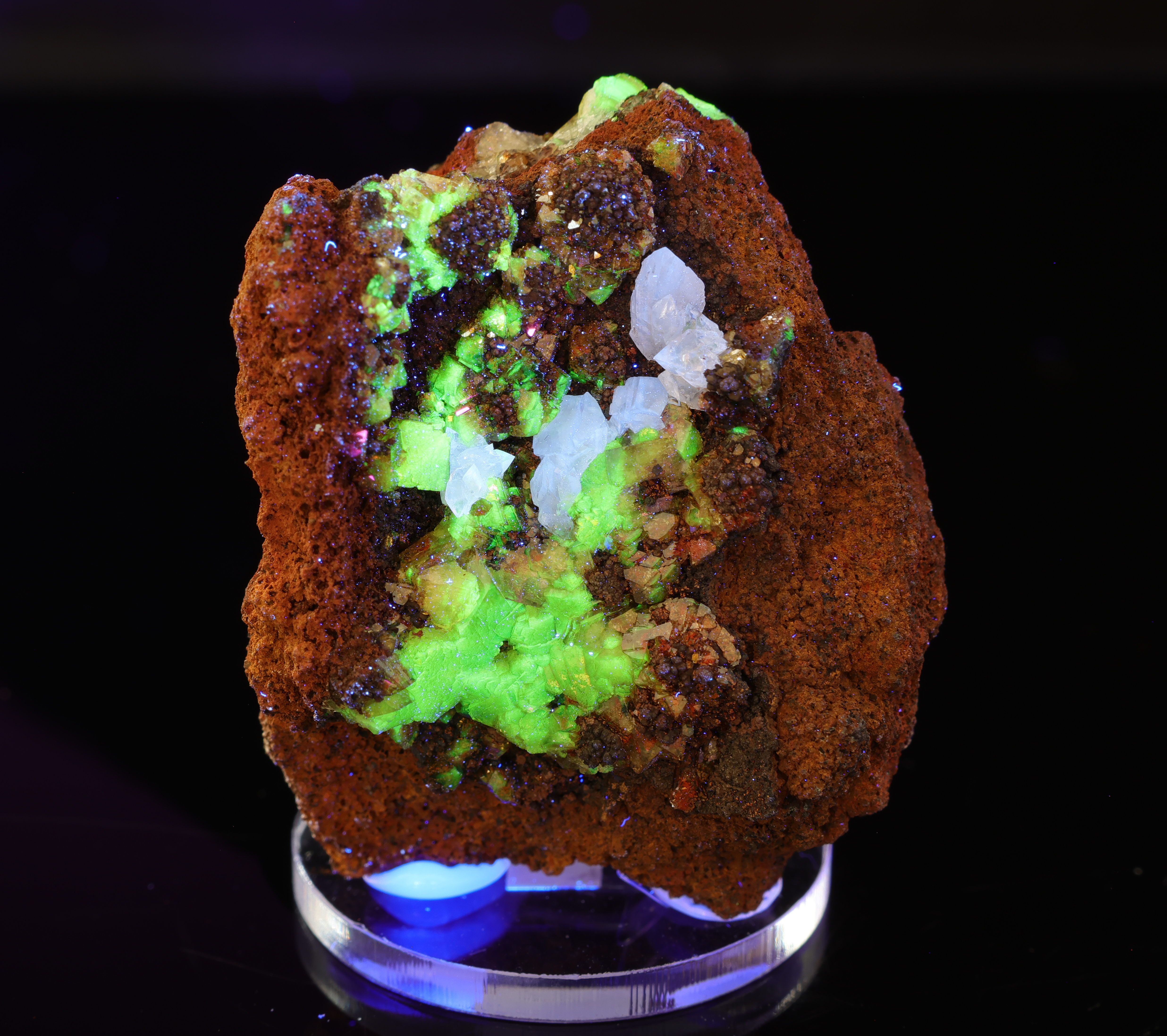
Adamite is a rare mineral from the arsenate group, often found in the oxidation zones of zinc deposits, known for its intense colors and fluorescence.
Properties
- Mohs hardness
- 3.5
- Luster
- Vitreous
- Streak
- white
- Density
- 4.32
- Cleavage
- on {101}, good; on {010}, poor.
- Fracture
- Muszlowy do nierównego
- Transparency
- Transparent,Translucent
- Crystal system
- Orthorhombic
Diagnostic features
## Identification Adamite can be identified by its characteristic colors, especially bright green or yellow, and its typical vitreous luster. It often forms radial or reniform aggregates, as well as small, well-formed crystals. An important diagnostic feature is its fluorescence under UV light, often intensely green or yellow. ## Distinguishing from Similar Minerals Adamite is sometimes confused with olivenite, which is also a copper and zinc arsenate, but usually has a darker green color and a different crystal habit. Aurichalcite can also be similar, but it usually has a lighter, more bluish-green color and is much softer. Differentiation often requires laboratory tests, such as chemical composition analysis. ## Crystal Forms Adamite crystallizes in the orthorhombic system. Crystals are usually small, prismatic or tabular, often forming radial, reniform, spherical, or botryoidal aggregates. Aggregates can be massive or granular.
Geological environment
## Genesis Adamite is a secondary mineral, formed in the oxidation zones of zinc ore deposits, where arsenic-rich hydrothermal solutions react with zinc minerals. It occurs in paragenesis with other minerals of the oxidation zone. ## Mineral Associations Adamite often co-occurs with minerals such as limonite, hemimorphite, smithsonite, malachite, azurite, calcite, quartz, and gypsum. ## Localities Known adamite localities include the mines in Mapimí, Durango, Mexico, where some of the most beautiful specimens have been found. Other important occurrences are Tsumeb in Namibia, Laurion in Greece, Cap Garonne in France, and Broken Hill in Australia.
Rarity
Uncommon
For collectors
## Quality Criteria The most prized adamite specimens are characterized by intense, bright color (especially green or yellow), good crystal transparency, and distinct luster. The size and aesthetics of crystal aggregates, as well as the absence of mechanical damage, are also important. Specimens exhibiting strong fluorescence are particularly sought after. ## Popular Localities The most sought-after adamite specimens come from the Ojuela mine in Mapimí, Mexico, famous for its large, well-formed crystals of beautiful color. Other prized localities include Tsumeb in Namibia, known for rare color varieties, and Laurion in Greece.
Care and storage
## Cleaning Adamite is a relatively soft mineral, so it should be handled with care. For cleaning, it is best to use a soft brush and lukewarm water. The specimen can be gently rinsed under running water or briefly immersed in distilled water. Avoid vigorous scrubbing, which could scratch the surface of the crystals. ## What to Avoid Do not use any chemical cleaning agents, acids, or solvents, as they can damage the mineral. Adamite is sensitive to high temperatures and prolonged exposure to sunlight, which can cause colors to fade. Rapid temperature changes should also be avoided. Due to its arsenic content, it is recommended to avoid direct contact with the mouth and to wash hands after handling the specimen. ## Storage Adamite is best stored in a closed display case or box, away from dust and direct sunlight. A dry and stable environment is ideal. Specimens with delicate, radial aggregates should be protected from mechanical damage.